
Manson YI Release Paths
Manson Youth Institution is operated by the Connecticut Department of Correction. CT DOC describes it as the department’s primary location for accused or sentenced people under age 22 and says it holds males ages 15 through 21. The institution combines correctional custody with age-based legal boundaries. Some people may have public adult DOC records. Others may have juvenile or youthful-offender matters that official public systems exclude.
A person can leave Manson after a court order, transfer, sentence discharge, parole or special parole transition, or a detainer handoff. Transfer within DOC does not end custody. A move to another agency is not release to the community. For a public adult record, status, location, release dates, court disposition, and supervision details can identify the event. For a protected youth matter, only an authorized person or the proper official process may obtain information.
| Record situation | Correct route |
|---|---|
| Public adult DOC custody | CT DOC search and DOC records |
| Public criminal case | Judicial Branch lookup and clerk record |
| Juvenile or youthful-offender matter | Authorized court or agency process only |
| Release to supervision | DOC, BOPP, and Parole and Community Services |
| Detainer transfer | DOC movement record and receiving authority |
The key rule is simple: do not turn a privacy boundary into a claim about custody.
Search Public Manson Releases
For information lawfully available about an adult in DOC custody, use the CT DOC inmate information search. Search by DOC number if known, then verify name, date of birth, latest admission, current location, status, offense, sentence, and release fields. The public search uses a nightly feed from OBIS. It does not function as a permanent youth release archive.
- Decide whether the matter is likely public adult DOC custody or subject to a youth-record restriction.
- Search CT DOC only for a public record and confirm identity through more than the name.
- Read current location with status to separate a Manson exit from an in-system transfer.
- Use public court sources only where the case type is displayed by law.
- For an unclear public adult record, request a precise release or movement record from DOC.
The Judicial Branch criminal lookup states that youthful-offender and juvenile cases are excluded. It also excludes some other case types and changes public records after erasures, corrections, pardons, and modifications. Respect those boundaries. A family member, attorney, or authorized party should use the process supplied by the court or agency for nonpublic information.
Note: Public adult data and protected youth data can arise at the same institution, so confirm the record category before searching.
Manson YI Records Contact
The official Manson Youth Institution page is the source for facility facts and contact information. Current operational questions can start at the institution. Formal public-record requests for releasable adult DOC movement, status, or discharge material go through DOC External Affairs Freedom of Information.
Manson Youth Institution
42 Jarvis Street
Cheshire, CT 06410
Phone:
203-806-2500
Fax: 203-699-1845
DOC FOI is at 24 Wolcott Hill Road, Wethersfield, CT 06109, phone 860-692-6290 and fax 860-692-7873. Its official request page links to GovQA. For a public adult record, include the full name, DOC number if known, facility, approximate dates, and a narrow description such as public movement history or records showing release date and type.
Do not ask staff to disclose juvenile, youthful-offender, sealed, education, medical, or other protected information through a general public request. Connecticut FOIA has law-enforcement exemptions, and court sealing rules also apply. DOC can review the request and state what public material exists. Ask for an estimate of timing and fees because redaction and legal review may affect the response.
Manson YI Youth Boundaries
Manson is a Level 4 institution made up of ten separate buildings. Its age range and mission are the most distinctive parts of the release-record problem. An accused person has not reached final disposition. A sentenced person has received a court term. Age alone does not identify whether a record is public, and placement at Manson does not make every underlying case a juvenile case.
The official CT DOC facility capture below identifies Manson’s correctional role and grounds the contact details in the state source.
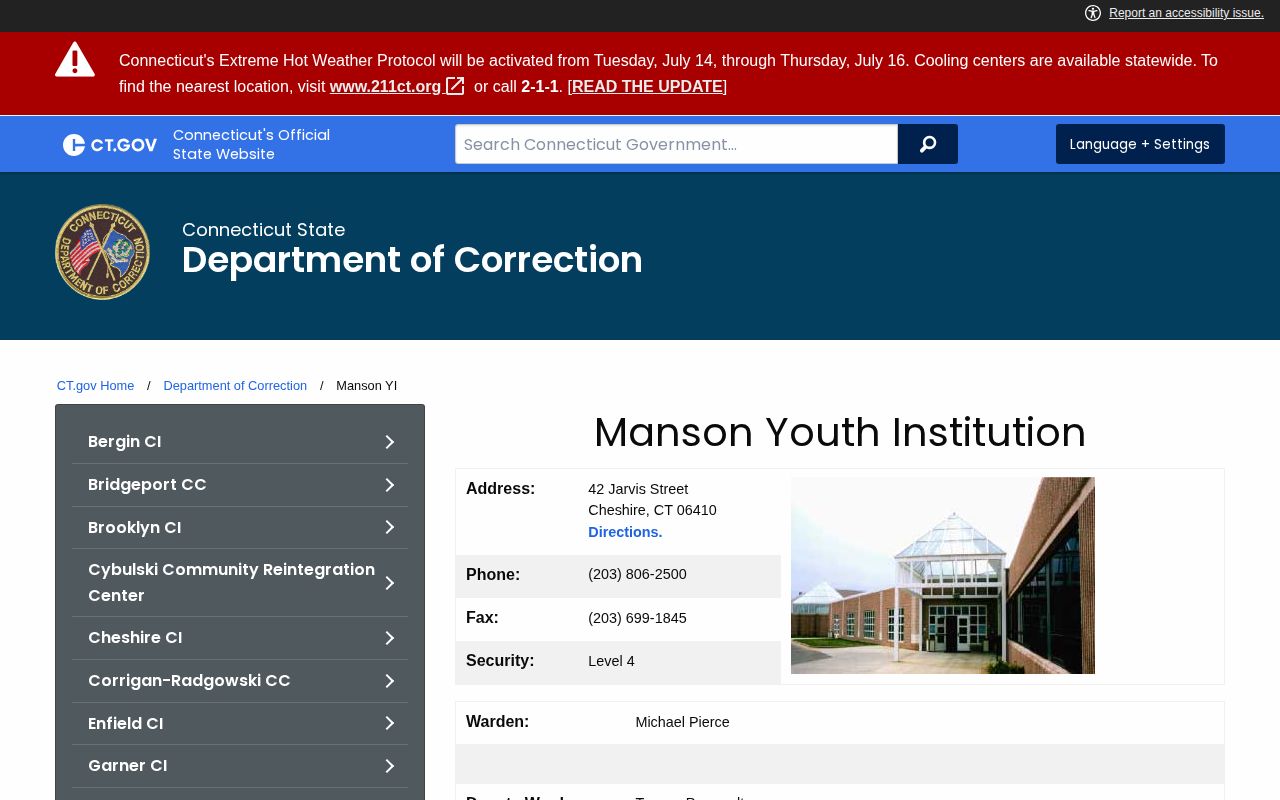
The image supports the facility profile, but a person-specific release still requires an eligible public record or authorized inquiry.
Connecticut court search generally shows conviction information online for no more than 10 years after sentencing and excludes juvenile and youthful-offender matters. Records can also change after an erasure or pardon. These limits protect legal record treatment and prevent the public search from serving as a complete historical archive. When no record appears, report only that no public match was found.
Manson YI Release Dates
CT DOC’s public field inventory includes maximum release date, estimated release date, and special parole date. Each means something different. The maximum date relates to the sentence framework. The estimated date is a projection affected by the record and applicable credits. A special parole date can mark the shift from confinement to court-ordered supervision. None should be relabeled as an actual release without confirmation.
The Board of Pardons and Paroles explains parole eligibility and decisions for qualifying sentences. Eligibility means a person may be considered, not that release has been granted. Earned risk reduction credit and statutory rules can affect calculations, while conduct, sentence changes, detainers, and decisions can alter the outcome. Youth and young-adult eligibility can also involve specific statutory rules that should not be guessed from age.
For an actual public adult Manson release, compare the last DOC status with the court and any BOPP action. If the data remains uncertain, ask for the public portion of the release calculation or discharge record. The New Haven projected release date resource explains the statewide date fields without treating projections as guarantees.
- Estimated release date
- A DOC projection, not a confirmed exit.
- Maximum release date
- A sentence-based outer date shown in the DOC field set.
- Special parole
- A supervision term imposed by the court after incarceration.
- Discharge
- The official end of the applicable custody or sentence status.
Manson YI Supervision Releases
A person released from Manson may enter parole, special parole, transitional supervision, or another qualifying community status. Parole and Community Services supervises people under the jurisdiction of CT DOC and the Board of Pardons and Paroles. The correct district office usually depends on the community destination rather than Manson’s Cheshire address.
A community status means the person is outside the prison but can remain under rules and reporting duties. Verify the exact status through DOC and the proper supervision contact. A BOPP hearing or eligibility listing does not by itself show that the person completed release. If a violation later results in revocation, custody can resume and current records may differ from the original release record.
VINE can provide custody notifications where applicable, but it is not a court docket or full historical record. For protected cases, notification access and disclosure may follow separate legal rules. Use the system only for its stated purpose and do not assume its silence means an unreported youth release.
Note: The supervision office serving the release destination may differ from the office nearest Manson Youth Institution.
Manson YI Detainer Releases
Detainer information can appear in the CT DOC public field set when disclosure is allowed. A detainer is a request or hold from another authority. A person who leaves Manson on a detainer has exited that institution but may enter another jail, federal process, or immigration custody. That event is not release to the community.
Follow a federal sentenced case through the Federal Bureau of Prisons locator and the District of Connecticut court route. Immigration custody uses ICE’s Online Detainee Locator System. State court data, federal dockets, BOP data, and ICE data are distinct. If the receiving agency is unclear, request the public DOC movement history rather than guessing.
The safest Manson record statement is narrow: confirm the last public status, identify any shown transfer or detainer, and note when youth confidentiality prevents public confirmation. The New Haven custody and release overview can help identify another system without overriding these youth-record limits.