
New Haven County Release Dates
A projected date is a calculation based on facts known at a given time. An actual release is the event recorded when the person leaves that custody status. Connecticut DOC publishes several date concepts, including minimum, maximum, estimated, and special-parole dates where applicable. These fields do not all mean the same thing. The estimated date is the closest official field to the everyday phrase “projected release date,” while a maximum date reflects a different sentence endpoint and a special-parole date signals a transition into a supervision term.
New Haven Correctional Center primarily houses pretrial people. For that group, a prison-style estimate may not answer the question. Bond, a promise to appear, dismissal, nolle, sentence, court order, detainer, or transfer can control what happens next. A nolle is a prosecutor’s decision not to pursue a charge at that time. A detainer is a request or hold from another authority. Either can affect the path without producing a simple calculated release date.
Find New Haven County Release Dates
The Connecticut DOC inmate information search is the central lookup because the state runs both its pretrial jails and sentenced prisons. Search with a CT DOC number when known. Otherwise, use the legal name and verify the match with date of birth, latest admission date, location, status, bond, controlling offense, and sentence fields. A person at New Haven Correctional Center may be awaiting court, while a person at Cheshire, Manson, York, or another institution may be serving a sentence or held under a different DOC status.
- Identify whether the person is pretrial, sentenced, under federal authority, or already in community supervision.
- Search CT DOC by number or name and confirm the identity with more than one field.
- Read Estimated Release Date with Maximum Release Date, Special Parole Date, status, and detainer information.
- For a pretrial person, check bond and status, then review the Judicial Branch pending case or daily docket.
- For a sentenced person, compare the DOC estimate with the sentence, credits, and BOPP parole information.
- Ask DOC records or the responsible court about a conflict, missing field, or later recalculation.
The manifest provides a successful capture of the official CT DOC search entry.
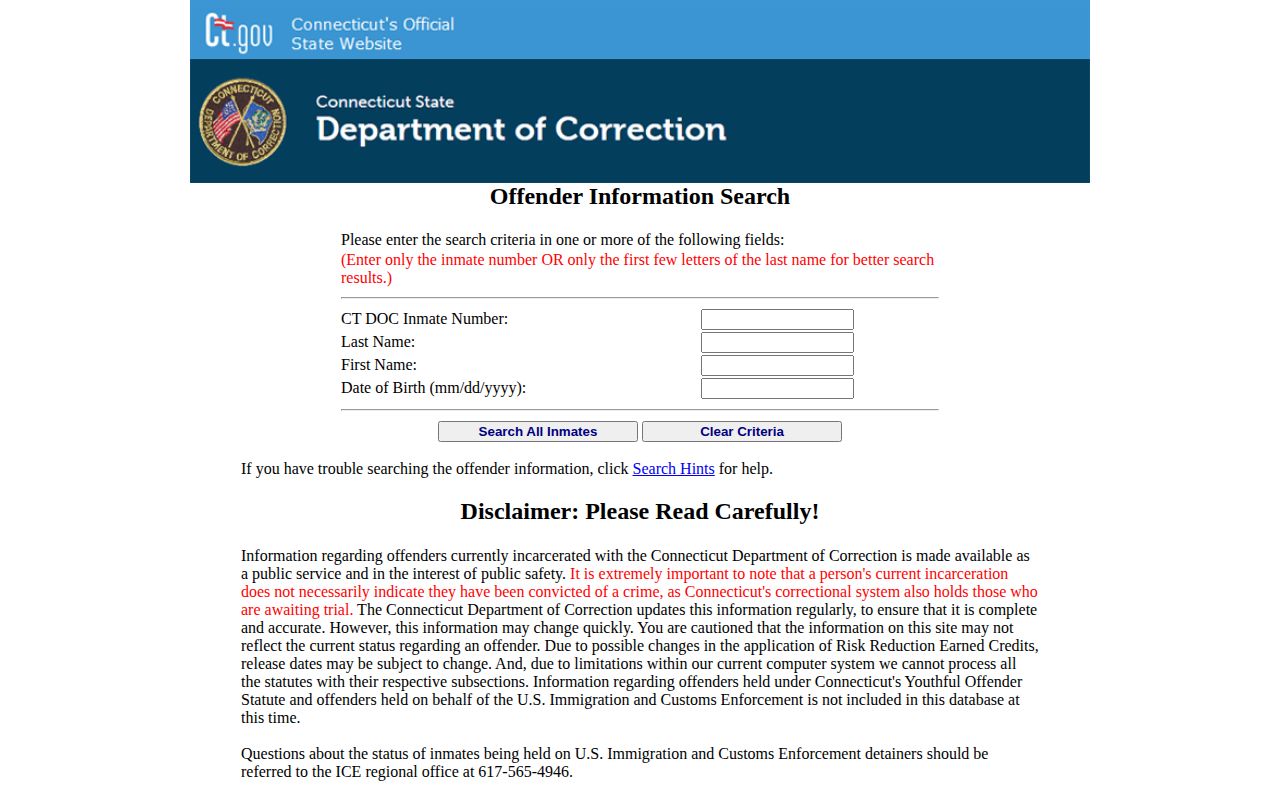
The statewide entry reflects Connecticut’s unified correction system, so it covers the state-operated New Haven jail and prison network rather than a county sheriff roster.
Note: The DOC public search receives a nightly OBIS feed, so a same-day change may not appear at once.
New Haven County Estimated Date Fields
Connecticut’s distinctive terminology matters. The public-facing consumer question is often “What is the projected release date?” CT DOC’s documented label is “Estimated Release Date.” The DOC Management Information Systems Unit says the public search may include maximum release date, estimated release date, special parole date, and detainer information. The DOC FAQ also lists minimum, maximum, and estimated release dates among information the agency may provide for a currently incarcerated person.
Read the fields as a group. An estimated date reflects a current calculation. A maximum date can mark a sentence limit before other legal details are considered. A special-parole date relates to the start of a court-imposed supervision term after incarceration. Detainer information can show why leaving DOC does not mean release from all authority. The sentence date, maximum sentence, jail credit, offense, and status add context. Not every record displays every documented field.
| DOC item | What it helps explain |
|---|---|
| Estimated Release Date | DOC’s current calculated estimate, not a guarantee. |
| Maximum Release Date | A maximum sentence-related endpoint shown by the public system. |
| Special Parole Date | A possible move from incarceration into a special-parole term. |
| Bond amount and status | More useful than an estimate for many pretrial custody questions. |
| Detainer information | A sign that another authority may take custody or continue a hold. |
| Latest admission and location | Context for the current DOC custody episode and facility. |
This terminology is the Section 19 projected-date angle assigned to the page: New Haven County users should translate “projected” to the DOC “Estimated Release Date” field, then apply Connecticut’s specific RREC and parole limits.
New Haven County RREC Rules
Connecticut calls its relevant earned-time mechanism Risk Reduction Earned Credit, or RREC. Under Connecticut General Statutes Section 18-98e, an eligible sentenced person may earn up to five days per month at the Commissioner’s discretion. Eligibility has statutory limits and exclusions. Credit is based on adherence to an offender accountability plan, participation in eligible programs or activities, good conduct, and obedience to rules. Good conduct by itself is not enough.
RREC can be lost for misconduct, insubordination, refusal to follow recommended programs or institutional rules, or other good cause. It cannot reduce a mandatory minimum term. Before a release based on RREC, the Commissioner or a designee must review the record and verify the credits. That review is one reason a public estimate is better understood as a changing official calculation rather than simple arithmetic done from a sentence length.
The statute applies to eligible sentenced people committed for covered crimes and contains exclusions that cannot be resolved from a name and sentence length alone. Do not subtract five days for every month and present the result as an official New Haven County release date. The award is discretionary, eligibility is fact-specific, and credits may change. DOC’s current estimate already reflects the agency’s calculation snapshot. A records inquiry is the proper route when a person needs the credit history or an explanation for a change.
- RREC
- Risk Reduction Earned Credit awarded under Connecticut law to eligible sentenced people at the Commissioner’s discretion.
- Jail credit
- Credit for qualifying time already spent in custody before or during sentence calculation.
- Mandatory minimum
- A term that the earned-credit statute cannot reduce below its legal floor.
- Recalculation
- An agency correction or update to sentence, credit, date, or custody information.
Note: Section 18-98e permits up to five days monthly for eligible people, but it does not promise that amount.
New Haven County Parole Thresholds
Parole eligibility is another date, not the same as the estimated end of custody. The Connecticut Board of Pardons and Paroles eligibility page says that many people serving definite sentences of at least two years and one day may be considered after serving at least fifty percent of the total effective sentence, less qualifying jail or risk-reduction credits. Eligibility only permits Board consideration. It does not establish suitability or require release.
The often-used “eighty-five percent” phrase has a narrower Connecticut meaning. People whose offenses involve the use, attempted use, or threatened use of physical force against another person must serve at least eighty-five percent of the total effective sentence, less jail credit, before BOPP may parole them. For offenses committed on or after July 1, 2013, RREC does not reduce that eighty-five-percent parole-eligibility date. It is inaccurate to say every Connecticut inmate must serve eighty-five percent.
Section 54-125a supplies the statutory parole framework and includes other rules for specified offenses and long sentences involving people who were young at the time of the offense. Because those categories are fact-specific, the DOC calculation and BOPP record should control instead of a hand estimate.
Why New Haven County Dates Change
A date can move even when the sentence itself appears unchanged. Credits can be earned, denied, lost, or corrected. Jail credit may be adjusted. A court can modify a sentence or custody order. DOC can correct a calculation. A disciplinary event can affect credit. Parole can be granted, denied, deferred, rescinded, or later revoked. A nightly public feed can also display the effect after the underlying agency record changed.
| Factor | Possible effect on the date or release |
|---|---|
| RREC earned or lost | Changes qualifying credit within statutory and agency limits. |
| Jail-credit correction | Revises credited time already served. |
| Court order or sentence correction | Changes the legal basis for the custody calculation. |
| Discipline | May cause loss of credit or another custody consequence. |
| Parole decision | May grant, deny, defer, rescind, or revoke a release path. |
| Detainer or transfer | May move the person into another agency’s custody instead of the community. |
| Nightly feed timing | May delay public display of a change already made in the source record. |
A detainer deserves special care. Release from Connecticut DOC on a date may mean transfer to a federal, immigration, out-of-state, or other law-enforcement authority. If a detainer appears, identify that agency and use its locator or court source. “No longer at New Haven Correctional Center” is not the same as “free from all custody.”
Confirm New Haven County Release Dates
For a sentenced state prisoner, compare the latest DOC fields with the court sentence and any BOPP hearing information. For a pretrial person, use bond and status fields with the Connecticut Judicial Branch criminal lookup. Pending cases, daily dockets, convictions, warrants, and docket-number searches can show the event that changes custody. New Haven Correctional Center serves courts in Meriden, New Haven, Bantam, Litchfield, and Waterbury, so search by defendant or docket rather than assuming the event occurred at one courthouse.
When the public fields conflict or omit an important detail, DOC records can provide the official route. The DOC FOI office accepts requests through its published process, while the Public Information Office addresses information concerning currently incarcerated people. A focused request should identify the person, CT DOC number, facility, relevant dates, and the release or sentence-calculation record sought. Restricted, sealed, juvenile, or safety-sensitive information may not be public.
Use Connecticut VINELink release alerts to follow a supported custody change for a specific person. VINE is a notice channel, not a sentence calculator. Final confirmation comes from the agency record, court action, and any later custody source. The most reliable answer records both the date shown and when the source was checked.