
New Haven County Parole and Probation
Connecticut assigns parole decisions, parole supervision, and probation to different bodies. The Connecticut Board of Pardons and Paroles, often called BOPP, decides whether an eligible sentenced person should receive parole. The Connecticut Department of Correction Division of Parole and Community Services then supervises many people released under the authority of BOPP or the Commissioner of Correction. Probation is different. It is imposed by a court and supervised through the Judicial Branch Court Support Services Division. A court case and its judgment are therefore central to confirming probation.
Parole usually follows a period of incarceration. Special parole is a term set as part of a criminal sentence that begins after the prison portion ends. Probation may follow incarceration, replace part of a jail term, or arise from a court disposition without a prison release. One person can have both parole and probation obligations. Another may complete a sentence with no community supervision at all. Status should not be inferred from an old arrest, a past jail stay, or a missing name in a custody search.
| Feature | Parole or special parole | Probation |
|---|---|---|
| Source | Release from DOC custody or a sentence term | Court order or sentence |
| Decision or authority | BOPP, DOC, or the sentence, depending on status | Connecticut Judicial Branch court |
| Local contact | New Haven Parole and Community Services | New Haven Adult Probation |
| Best record check | DOC status, BOPP materials, and parole office | Court docket, disposition, and probation office |
| Possible endpoint | Discharge, expiration, or approved early end | Court discharge or completion of the ordered term |
- Parole
- Conditional release from incarceration before the full sentence endpoint, subject to supervision and stated terms.
- Special parole
- A period of parole supervision imposed by the sentencing court to follow incarceration.
- Probation
- A court-ordered period of community supervision with conditions set or enforced through the Judicial Branch.
- Discharge
- The formal end of a custody or supervision status.
- Absconder
- A supervised person alleged to have stopped reporting or left supervision without approval.
Verify New Haven County Supervision
Start with the record that created the supervision. The CT DOC inmate information search may show current location, status, estimated release information, or special parole date for a matching DOC record. It is fed nightly from the Offender Based Information System, so it is an official public lookup but not a minute-by-minute certificate. For probation, use the Connecticut Judicial Branch criminal case lookup to find the case disposition, sentence, and later docket events. A person who left a facility is not proved to be on supervision merely because the person no longer appears in custody.
Follow a short verification chain. Match identity with care, identify the release type, then contact only the agency responsible for that status. The full New Haven County released-inmate search path can help when the original custody system is unclear.
- Collect the full legal name, approximate date of birth, docket number, and CT DOC number when known.
- Check the DOC record for status, location, sentence dates, special parole date, and any community-supervision signal.
- Search the Judicial Branch by defendant or docket to locate the sentencing court and any probation term.
- Review BOPP hearing or revocation materials when parole was granted, denied, rescinded, or later challenged.
- Call the New Haven parole office or Adult Probation only after identifying which agency has jurisdiction.
- Ask for the proper public-record or verification channel if staff cannot discuss an individual by phone.
Note: A current jail roster tracks custody, while parole and probation records address legal status after release.
New Haven County Parole Office
The New Haven Parole and Community Services office is the named local contact for people under DOC community supervision. It is not a jail and does not hold inmates. The office may address reporting arrangements, supervision transfers, or the correct district contact when a public inquiry concerns parole, special parole, transitional supervision, or another DOC community status. The statewide division also operates units for central intake, special management, mental health, residential services, women’s reentry, fugitive investigations, and other specialized needs.
620 Grand Avenue
New Haven, CT 06515
Phone: 203-937-2400
Fax: 203-937-2414
The official New Haven office page provides the agency location and contact details. The following image comes from that same source.
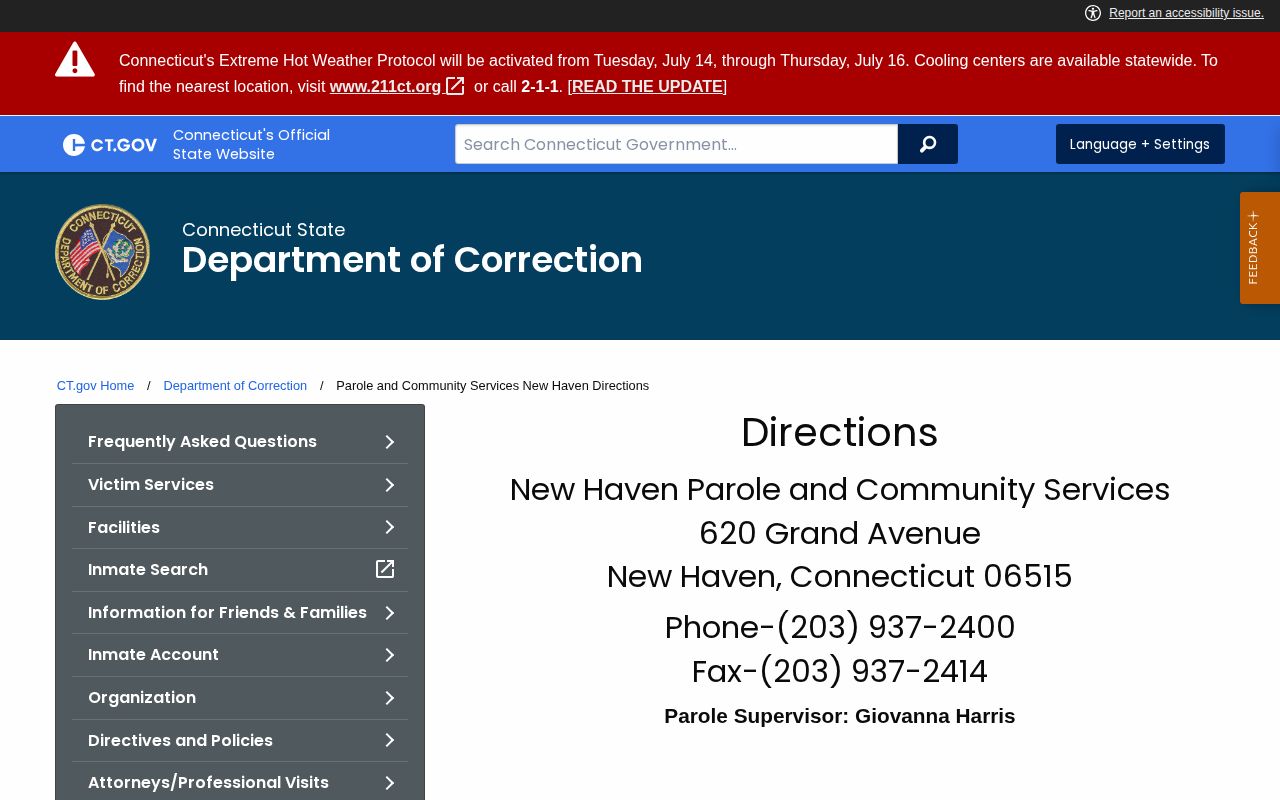
The state listing ties local post-release supervision to a specific New Haven office instead of a county sheriff department.
New Haven County Parole Hearings
Parole eligibility does not mean parole will be granted. Eligibility means BOPP is legally allowed to consider release at a certain point. Suitability is the Board’s separate decision about whether release should occur. The BOPP eligibility page explains the practical distinction and the general fifty-percent and violent-offender eighty-five-percent eligibility rules. Those percentages are eligibility thresholds, not promised release dates.
BOPP posts live hearing details and links through its home page and the hearings and event calendar. Hearings may be scheduled Monday through Friday, so current postings should be checked rather than assuming a fixed monthly cycle. Public outcomes can include a grant, denial, continuance, deferral, rescission, revocation, or special conditions depending on hearing type. No single searchable decision database was confirmed in the research. Hearing postings, DOC and court records, BOPP records requests, and the revocation unit are the supported paths.
New Haven County Absconder Cases
A person may be lawfully released and later face an alleged supervision violation. That event will not appear as a new item on a recent-release list. The DOC Division of Parole and Community Services lists a Fugitive Investigations Unit at 203-346-7830. The BOPP Revocations and Rescissions Unit schedules proceedings and issues decisions in parole rescission and parole or special-parole revocation matters. The Judicial Branch lookup also links to warrant information.
An absconder is a person alleged to have stopped reporting or left supervision without approval. A rescission can withdraw parole before release under the applicable process, while a revocation can end parole after release and return the person to custody. A violation allegation does not by itself show the final outcome. Check the hearing record, court docket, DOC status, and responsible unit. If a warrant is active, law-enforcement directions should be followed rather than arranging an informal meeting.
Note: VINE tracks supported custody changes, but it does not replace a warrant, revocation, or court-record check.
New Haven County Reentry Support
New Haven has a local handoff for people returning from incarceration. The City of New Haven Reentry Resource Guide directs people seeking reentry services to the Reentry Welcome Center at Project MORE, phone 203-865-5700 option 5. CT DOC’s Offender Re-Entry Services also names New Haven Project Welcome Home and describes coordination between correctional counselors and community welcome centers.
This reentry layer is distinct from supervision. A welcome center can help connect a released person with documents, referrals, and community support, but it does not decide parole, alter probation, or certify discharge. The parole officer, probation officer, court, or DOC record remains the source for legal status. When the person is under supervision, service plans and reporting rules should be coordinated with that supervising office.
New Haven County ID Retrieval
Connecticut has a specific path for identification left with DOC after discharge. DOC says identification stays at the last discharging facility for thirty days. After that point, it is sent to DOC Central Office and held for up to two years. Someone released recently should first contact the last assigned facility. After the first thirty days, DOC Reentry Services can be reached at 860-692-6836 or 860-692-7869, or by email at DOC.ORSU@ct.gov.
United Way 211 Connecticut confirms the same time-based route. This matters for New Haven County parole and probation because a state ID can be important for reporting, services, transportation, and other routine tasks after release. The identification process does not prove the person’s supervision status, and the parole office does not replace the discharging facility as the first contact within the initial retention period.
Ending New Haven County Supervision
Supervision ends through an authorized discharge, expiration, court action, or approved early termination process. The exact route depends on whether the status is parole, special parole, probation, or another DOC release program. A person should not treat the last scheduled meeting, a change of officer, or a missing online result as proof that all obligations ended. Written discharge information, the court docket, and the responsible agency provide stronger confirmation.
For parole, BOPP and DOC records may document the release decision, later violation proceedings, and the supervision endpoint. For probation, the sentencing court and Judicial Branch record are central. Court records can change due to corrections, erasures, pardons, or other lawful modifications. Older or restricted matters may require a clerk or formal records request. When a public portal does not settle the question, ask the responsible office how to request the releasable supervision or discharge record.
A discharge means a specific legal status has ended. It does not rewrite the earlier court or custody history, and it does not prove that no other case, detainer, or form of supervision exists. Compare names, docket numbers, DOC identifiers, and dates across sources before reaching a conclusion.