
New Haven Supervision Role
The Connecticut Department of Correction Division of Parole and Community Services supervises people released to the community under the jurisdiction of the Commissioner of Correction and the Connecticut Board of Pardons and Paroles. Its New Haven office is a district contact in that statewide system. It does not book, confine, or release inmates from a cell. A person reaches its scope after an authorized correctional transition.
Parole usually follows a BOPP decision for an eligible sentence. Special parole is imposed by a court and follows incarceration. Transitional supervision and other DOC statuses have their own authority. Probation is court supervision and is not the same as parole. The local parole office should not be used as a general jail roster or as proof that every released person has supervision.
| Status | What the New Haven office does |
|---|---|
| Parole | Local supervision when New Haven is the assigned district |
| Special parole | Supervision for the court-imposed post-incarceration term |
| Transitional supervision | DOC community oversight when assigned |
| Probation | Handled through the Judicial Branch probation system, not this parole office |
| No supervision | The office has no detention or general release-list role |
Verify New Haven Release Supervision
Start with the CT DOC inmate information search. The public field set can include status, current location, estimated release date, maximum release date, special parole date, and detainer information. A community or supervision status is more relevant than mere absence from a prison location. Because the feed updates nightly, confirm time-sensitive changes.
- Search the person in CT DOC and verify the DOC number, date of birth, location, and status.
- Check whether a special parole date or community status appears and distinguish it from a projected date.
- Use the Board of Pardons and Paroles source for hearing or decision context when parole applies.
- Confirm that New Haven is the assigned district before using the local office for reporting information.
- Use DOC or BOPP records when a public screen cannot confirm the release and supervision path.
The office can be a local verification point for the supervision relationship, but disclosure may be limited. Ask a narrow question about the correct district or official contact. For complete named-person release searching, use the New Haven release and records route before calling a supervision office.
Note: The office serving the release destination may differ from the institution or court area where the sentence began.
New Haven Parole Office Contact
The official New Haven office page provides the location and direct numbers. It is appropriate for district-office directions and official local supervision contact. It is not a walk-in custody locator, records archive, or substitute for an assigned officer’s instructions.
New Haven Parole and Community Services
620 Grand Avenue
New Haven, CT 06515
Phone:
203-937-2400
Fax: 203-937-2414
The statewide Parole and Community Services office is at 24 Wolcott Hill Road, Wethersfield, CT 06109, phone 860-692-6901. CT DOC lists a Fugitive Investigations Unit at 203-346-7830. Those numbers have different roles. Routine district questions belong with the assigned office, while fugitive matters follow the specialized unit and official law-enforcement process.
Formal DOC records requests can go to External Affairs Freedom of Information at the same Wethersfield address, phone 860-692-6290. Ask for the public portion of records showing release to supervision, assigned community status, or discharge when releasable. BOPP has its own record and hearing sources. Send the request to the agency that created the record.
New Haven Office Is Not Custody
The New Haven office’s listing beside detention facilities can cause confusion. Its facility-map entry exists because it answers a key post-release question, not because it has cells. “Released to parole” means release from incarceration into supervision. It does not mean transfer to 620 Grand Avenue for confinement. The office provides a reporting and supervision base.
The successful official BOPP capture below shows public hearing information that can explain the decision stage before some releases to supervision.
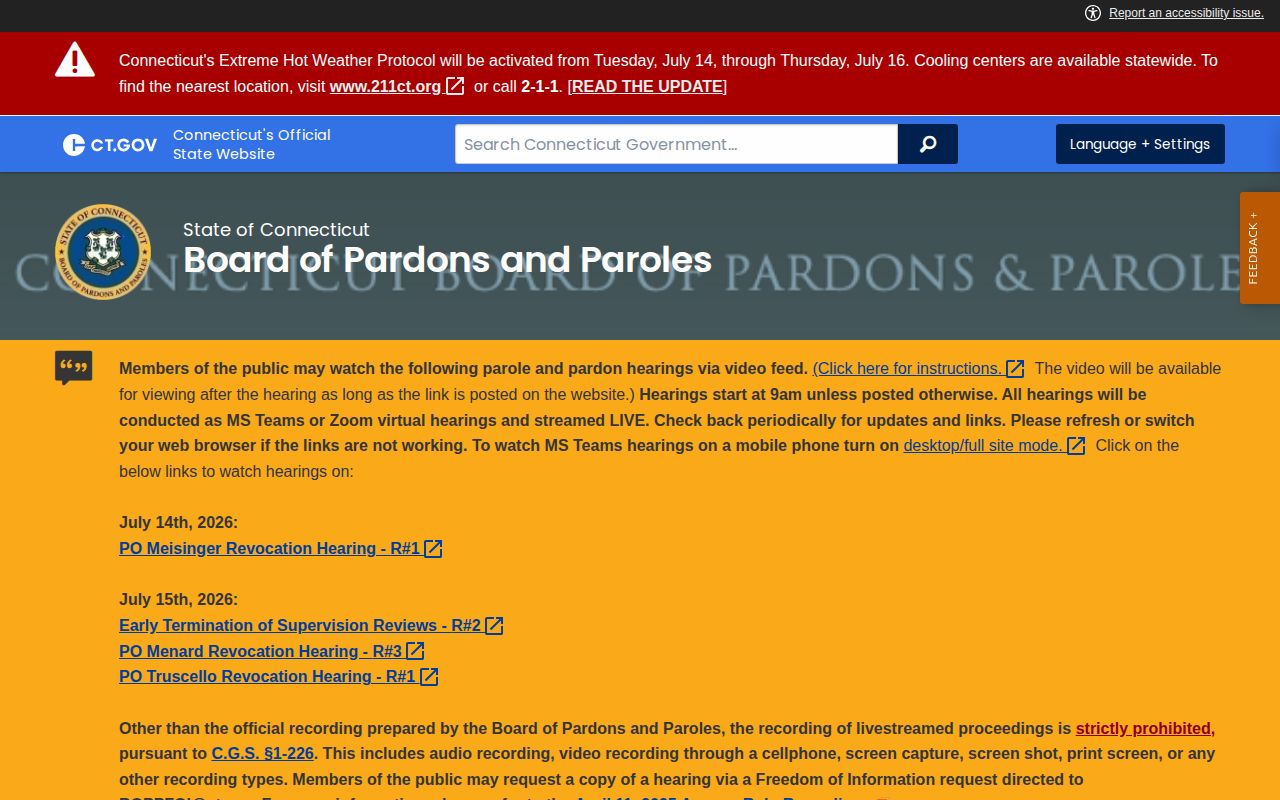
A hearing source supplies decision context. The DOC custody status and local office confirm the later supervision stage.
Someone who completed a sentence with no supervision does not become a client of this office merely because New Haven is home. Someone on Judicial Branch probation also follows the probation route. Identify parole, special parole, transitional supervision, probation, or full discharge before choosing an agency.
New Haven Supervision Records
BOPP hearing and decision material can show that a parole matter was considered, granted, denied, rescinded, or revoked. CT DOC records can show custody movement and community status. The district office handles the active local supervision relationship. These records overlap but are not interchangeable.
If a release is in doubt, request the public DOC record showing the movement from confinement to community status. For a hearing recording or BOPP-created decision, use BOPP’s official channels. For a later discharge from supervision, ask for the public record created by the responsible agency. Include full name, DOC number when known, approximate date, and the exact status or event sought.
- Parole
- Conditional community release approved for an eligible sentence.
- Special parole
- A court-imposed supervision term after incarceration.
- Absconder
- A supervised person alleged to have stopped reporting or left supervision without authority.
- Revocation
- A process that can end community release and return a person to custody.
- Discharge
- The official end of the supervision or sentence status.
Note: Ask the record creator for the document, since the local office, BOPP, and DOC custody units hold different records.
New Haven Violations After Release
A person may be validly released and later face a violation, warrant, or revocation. That later event does not erase the original release. It changes current status. CT DOC’s Fugitive Investigations Unit handles a specialized part of the supervision system, and BOPP has a Revocations and Rescissions Unit for parole rescission and parole or special-parole revocation proceedings.
Do not expect a recent-release list to show these later events. Recheck the current DOC status, official warrant sources, and BOPP records. If the person returned to custody, the current location field may identify the institution. If a matter is pending, a hearing or decision source can explain the stage without proving the final outcome early.
Safety or urgent law-enforcement concerns belong with the proper agency, not a public-record search. Routine verification should remain narrow: confirm whether supervision exists, identify the assigned office, and obtain the public decision or custody record. Avoid interpreting a missed appointment or rumor as official absconder status.
After New Haven Supervision Release
CT DOC’s reentry framework connects correctional release with local services. The City of New Haven Reentry Resource Guide directs people to the Project MORE Reentry Welcome Center at 203-865-5700 option 5. CT DOC separately names New Haven Project Welcome Home and says reentry counselors coordinate warm handoffs. These programs help with transition and referrals; they do not verify custody or supervision status.
Identification documents have a separate state process. DOC says IDs remain at the discharging facility for 30 days, then go to Central Office for storage for up to two years. The documented contacts are 860-692-6836, 860-692-7869, and DOC.ORSU@ct.gov. A person within the first 30 days should contact the last assigned institution, not the parole office, unless an officer gives different case-specific direction.
Supervision eventually ends through an official discharge or sentence event. Confirm that endpoint with the agency record. Stopping active prison custody, beginning supervision, completing supervision, and recovering property are four separate events. Keeping them separate produces an accurate New Haven release history.